
If you've ever ordered sushi or sashimi and wondered what that buttery, pale-colored fish labeled "white tuna" actually is, you're definitely not alone.
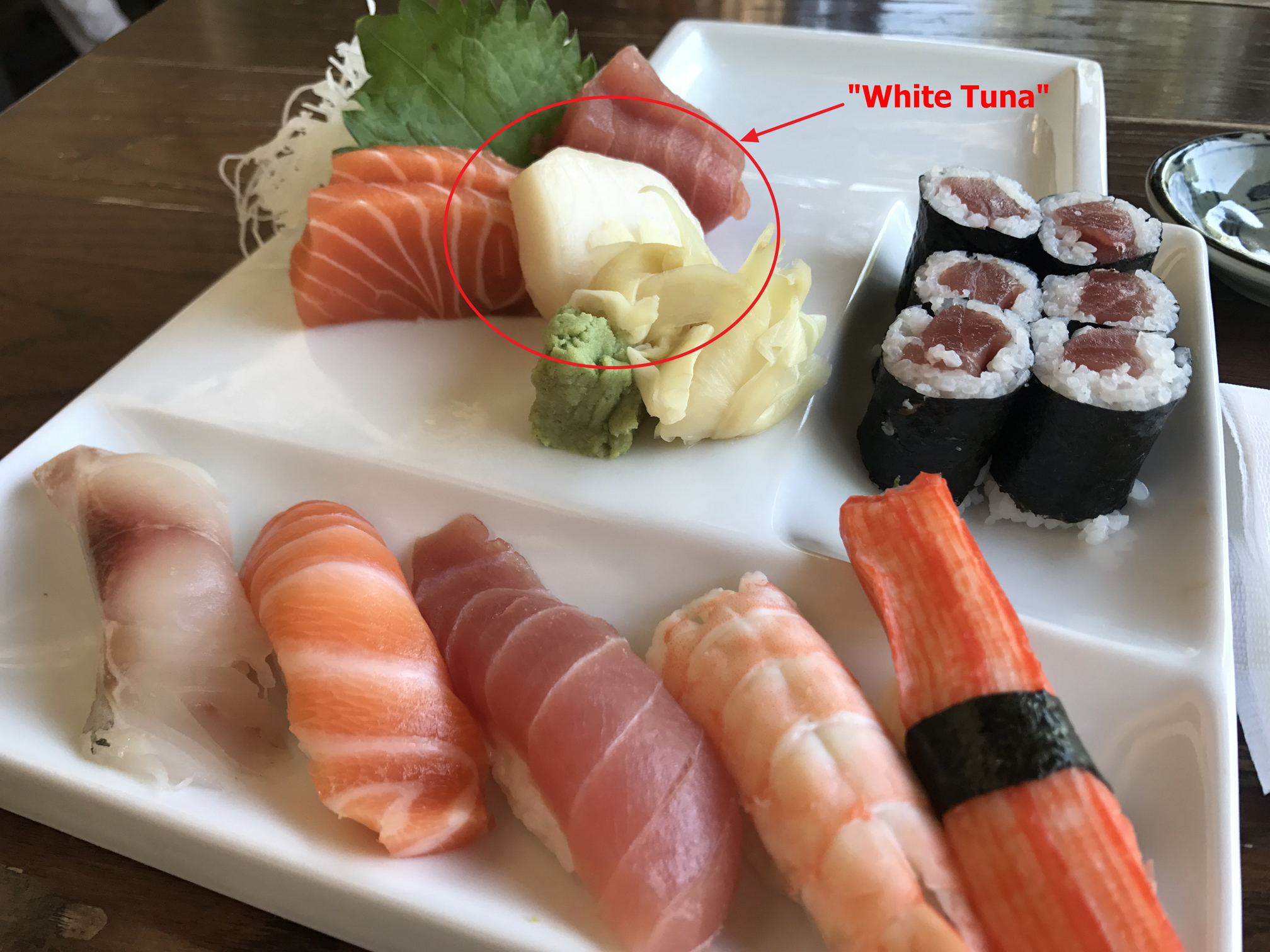
That's actually how I first started looking into this!
Years ago, I ordered one of my usual sushi and sashimi combinations at a local Japanese restaurant. Everything was delicious, but one piece of sashimi stood out because it was especially rich, soft, and almost buttery.
I asked the waiter what kind of fish it was.
"White tuna."
Simple enough... except I eventually learned that "white tuna" can mean very different things depending on what you're being served.
Sometimes it really is tuna - usually albacore tuna. Other times, especially on sushi menus, "white tuna" may refer to escolar, which isn't actually tuna at all.
And that distinction matters because escolar contains wax esters that our bodies don't digest well and can cause some pretty unpleasant digestive side effects.
So, What Is White Tuna?
There isn't just one answer.
The term white tuna can refer to albacore tuna, which is a true species of tuna. The FDA refers to albacore as "albacore/white tuna" in its fish guidance.
However, escolar is also sometimes called "white tuna," particularly on restaurant and sushi menus.
Escolar's scientific name is Lepidocybium flavobrunneum. It belongs to the Gempylidae family, commonly known as the snake mackerel family, so despite the nickname, escolar is not actually tuna.
The FDA lists the acceptable market names for this fish as Escolar or Oilfish. Interestingly, the FDA also lists "White Tuna" as a vernacular name for escolar, but notes that vernacular names generally aren't acceptable for labeling seafood in interstate commerce.
So if a menu simply says "white tuna," it's worth asking what fish you're actually getting.
Albacore vs. Escolar
Here's the easiest way to understand the difference:
Albacore
- Is a true tuna
- Scientific name: Thunnus alalunga
- Commonly called albacore or white tuna
- Has lighter-colored flesh than many other tuna species
Escolar
- Is not tuna
- Scientific name: Lepidocybium flavobrunneum
- Is part of the snake mackerel family
- May sometimes be sold or described as "white tuna"
- Has very rich, buttery flesh because of its unusually high wax ester content
That last part is also why escolar can cause digestive problems.
What Does Escolar Taste Like?
Honestly, I completely understand why people like it.
The first time I ate escolar, what stood out to me was how rich, smooth, fatty, and buttery it tasted. It practically melted in my mouth.
That texture comes in part from the unusual oils found in the fish.
Unfortunately, those oils are also where the problem begins.
Why Can Escolar Cause Digestive Problems?
Escolar contains large amounts of wax esters, a type of oil that humans don't digest very well.
Because those wax esters can pass through the digestive system without being absorbed normally, eating escolar can cause a digestive reaction known as keriorrhea.
Yes, this is the part of the article where things get a little gross.
Keriorrhea can involve the passage of an oily yellow or orange substance, and some people may also experience diarrhea, nausea, vomiting, abdominal pain, or headache.
Not everyone who eats escolar has a reaction. When symptoms do occur, Health Canada says they generally begin within a few hours and usually resolve within about 24 to 48 hours.
There also isn't a clearly established amount of escolar that is guaranteed to cause - or prevent - symptoms. Individual reactions can vary.
Is Escolar Poisonous?
Calling escolar "poisonous" can be misleading.
The issue isn't that eating a bite of escolar automatically causes food poisoning. Rather, the fish naturally contains wax esters that the human digestive system can't properly break down.
Some people eat small amounts and experience no noticeable problems at all, while others may develop gastrointestinal symptoms.
Health Canada notes that escolar can cause undesirable digestive effects in some people but does not consider it a life-threatening health risk.
That said, if you know you're sensitive to digestive issues, it's definitely something you'll want to be aware of before ordering it.
Is Escolar Banned?
This is another area where there's a lot of outdated information online.
Japan
Yes. Escolar is prohibited from being sold for food in Japan.
Japan's Ministry of Health, Labour and Welfare identifies escolar (アブラソコムツ) as a fish containing wax esters and states that its sale is prohibited under Japanese food sanitation rules.
Fun fact: the Japanese name アブラソコムツ (aburasokomutsu) includes abura, which means oil or fat - very fitting considering how oily the fish is!
United States
Escolar is sold in the United States, but the FDA identifies Escolar and Oilfish as its acceptable market names.
"White Tuna" is listed only as a vernacular name for escolar rather than an acceptable market name for labeling it.
European Union
You may see older articles claiming that escolar is banned in Italy or throughout parts of Europe.
Current European Union rules actually allow escolar to be sold, but it must be packaged and properly labeled. The label must inform consumers about preparation methods and the risk of gastrointestinal effects associated with the fish.
So I would no longer say that escolar is simply "banned in Italy."
How Do You Know If "White Tuna" Is Albacore or Escolar?
Unfortunately, you can't always tell just from the words white tuna on a restaurant menu.
The easiest thing to do is simply ask:
"Is the white tuna albacore or escolar?"
Albacore and escolar are completely different fish, so a restaurant should be able to tell you what they're serving.
And if you're ordering something labeled super white tuna, that's another good reason to ask exactly what species it is rather than assuming it's albacore.
Is Escolar Safe to Eat?
Whether you choose to eat escolar is ultimately up to you, but it's good to know what you're ordering first.
Some people eat escolar and have absolutely no noticeable reaction. Others can experience unpleasant gastrointestinal symptoms because of its indigestible wax esters.
Personally, after learning what escolar actually is and why it can cause digestive issues, I'd rather know exactly what's being served instead of seeing everything grouped together under the vague name "white tuna."
And that's really my biggest takeaway from this whole sushi discovery:
If a menu says "white tuna," ask whether it's albacore or escolar.
They may look somewhat similar on a plate, but they're definitely not the same fish.
Frequently Asked Questions
Is white tuna actually tuna?
Sometimes. Albacore is a real tuna species and is commonly called white tuna. However, escolar may also be called "white tuna" on some sushi menus even though it isn't actually tuna.
Is escolar the same thing as albacore?
No. Albacore (Thunnus alalunga) is a species of tuna. Escolar (Lepidocybium flavobrunneum) belongs to the snake mackerel family.
Why is escolar so buttery?
Escolar has a very high oil content, including large amounts of wax esters. This gives the flesh its rich, soft, buttery texture.
Can escolar cause diarrhea?
Yes. Because humans can't properly digest the wax esters in escolar, some people can experience oily discharge, diarrhea, nausea, abdominal discomfort, vomiting, or headache after eating it.
Does everyone get sick from escolar?
No. Reactions vary from person to person, and some people eat escolar without experiencing symptoms.
Why is escolar banned in Japan?
Japan prohibits the sale of escolar for food because its flesh contains wax esters that can cause gastrointestinal symptoms, particularly diarrhea.


Kevin T Huston says
What the article doesn't say is that it's the most amazing fish. No other is as tasty as it is. Needless in your mouth. I eat 3 ounces at most and it's amazing. No stomach issues.
FARRAH DIPIETRO says
I ork at a sushi restaurant. We sell “white tuna” all the time. No one has ever complained of indigestion to me before from this fish. I think the occurrence of sickness from it is less frequent than this article leads to believe.
Greayswandir says
Exactly! I've learned to be very skeptical of local news reports. You'd be amazed at how much they exaggerate their stories. I imagine they're ruined a lot of lives with their sensationalism and poorly balanced "journalism". After all, they're literally in a ratings war with their local competitors, and as they say, there are no rules in love or war.
Kelly @ A Girl Worth Saving says
Oh gross! I had no idea and this changes Sushi for me 🙁
STACEY CRAWFORD says
Oh no, I better warn my adult kids, they eat a lot of sushi and sashimi. Never heard of that before. Great information Tina, thanks.
Darryl says
I'm not a sushi fan but I need to check if that fish is available in the UK, what's the reason for the ban in Italy and Japan?
Tina T says
Basically for the reasons I listed. Here's a little more info after a bit more research: "Because of the unpleasant side-effects of eating oilfish and escolar, countries like Japan and Italy have banned the importation and sale of these fish, while Canada, Sweden and Denmark require they be sold with warning labels. In the US, the Food and Drug Administration has warned consumers about the dangers of eating oilfish, but lifted the ban in 1992, because the fish is non-toxic and poses no health risk." According to: http://www.odditycentral.com/foods/these-fish-are-so-delicious-youll-soil-yourself-literally.html
Kari - Get Inspired Everyday! says
Oh my goodness... I had no idea - thanks for sharing this!
Emily @ Recipes to Nourish says
Wow! I didn't know that I'm glad that it's not something I have eaten. Yikes! I'm going to make sure I tell my husband about that because he loves sushi.
ChihYu says
Oh my ! White tuna sounds fancy but little did I know it's something hmm... let's just stop there. Thanks for sharing the info !
Jessica DeMay says
Oh my gosh! I have never heard of this! I can't believe they're allowed to sell it. Thanks for the info!
Rachel says
Oh. My. Goodness. HOW is this legal to be sold, let alone under a misleading name like "white tuna"?!
Irena Macri says
Good to know! I'm assuming that happens due to fat malabsorption and digestion? Strange! Regular ol' pink tuna and salmon are good enough for my sushi fix - I'll pass on the digestive distress!
Michele Spring says
haha, I am NOT a sushi fan to begin with, but this isn't helping. Though I'll pass this on to my sushi loving family (I am the black sheep)
Jean says
Wait, what? WTF? I never knew this! Thanks for sharing. I'll have to watch out for it the next time we get sushi!
Holley @ ThePrimalDesire.com says
Crazy!! I had no idea, I wonder if it is available in Canada? Although I don't want to try it now...
Renee says
I didn't know this! Thank you for sharing!